


So a few months ago we posted an article about how IP Performance was helping Scotrail bring reliable, reslient internet connectivity to its services and passengers in the far north of Scotland by building a platform for the management and monitoring of their refitted Class158 units. This ongoing trial has been very well received by both the staff and customers of Scotrail, along with providing a wealth of realtime telemetry data and access Scotrail’s engineering teams didn’t have before.
Yesterday, Andy Millett, Principal Engineer at IP Performance was honoured to be invited to present the solution alongside members of Scotrail IT and Hitachi Rail Systems at TrainComm in London where Rail Operators, subject matter experts, solution providers, and manufacturers get together to share ideas, solutions and stories with each other about on-train connectivity and where it might take us in the future. What follows is an extract of Andy’s presentation.
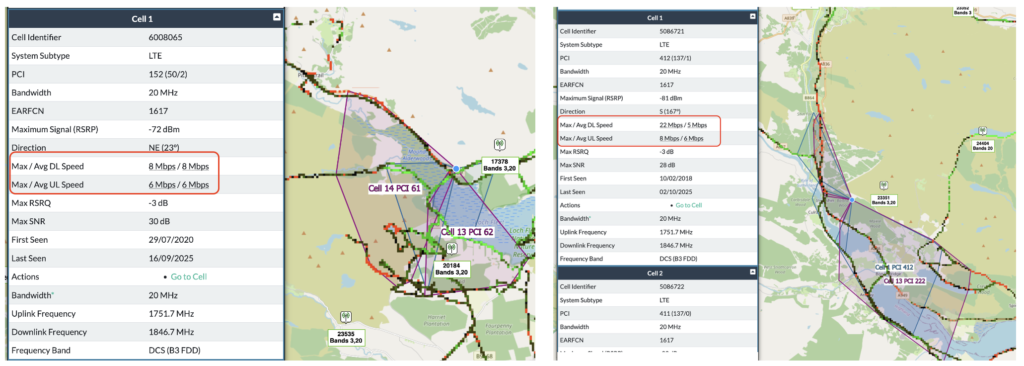
Connectivity challenges affect Scotrail daily and it’s pretty obvious that in Scotland there are large geographic distances between population centers with challenging connectivity problems especially the further north you go. Below are rail ‘not spots’ in Scotland courtesy of the Mast Database covering all four UK mobile providers.

Mobile providers will understandably prioritise connectivity where there are paying customers. They tried it with the Guild of Scottish Sheep Herds. The sheep didn’t pay their bill.
In short, there are vast geographical swaths of the Scottish rail network simply not provided for by land-based platforms on a consistent basis.
It’s not just that it’s an on-train public wifi problem, it’s a safety critical problem. With upcoming changes to mobile services on the horizon, alternatives for critical onboard systems become seriously challenging.
Even when there is connectivity to a cell, the cell backhaul in rural areas lags behind modern, high-capacity links to the service providers network.
When your train full of passengers whooshes by a local cell tower at 70mph, looking for a slice of 8 or 22 Mbps it’s no wonder disappointment, cursing and b…..b…..b……b….buffering ensue.
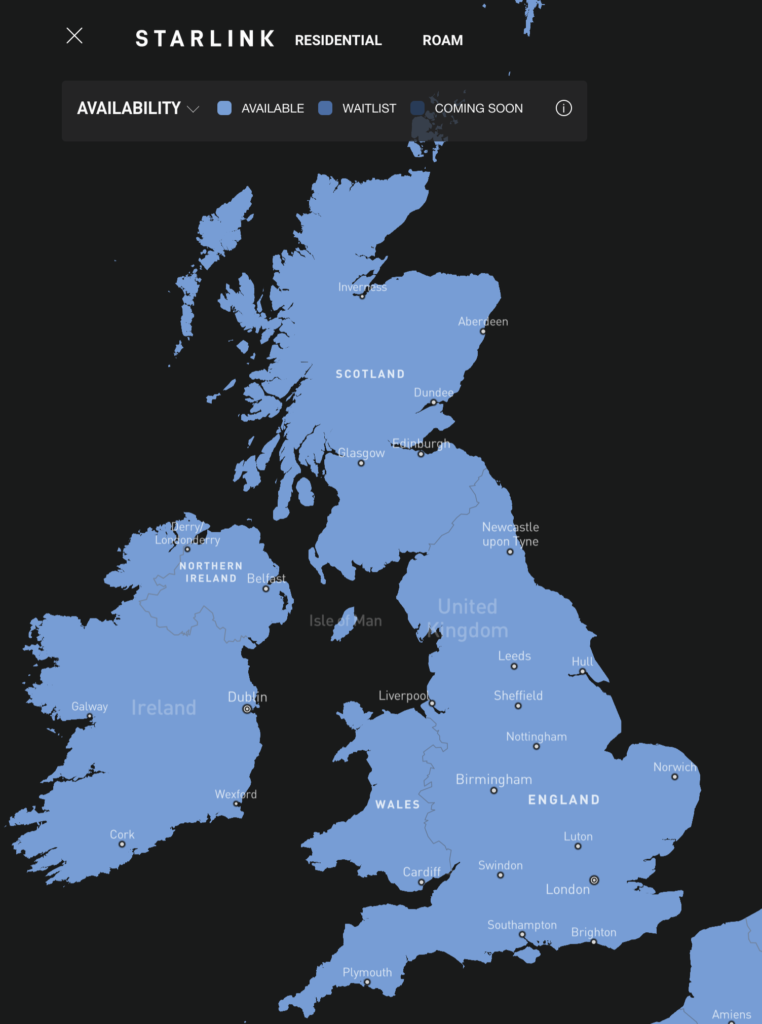
With the advent of LEO (Low Earth Orbit) connectivity from the likes of Starlink, Eutelsat or Amazon Leo there’s now a chance for meaningful change to provide a better service. If you were to look at the coverage map (below) from SpaceX, you’d be forgiven to think it’s a no-brainer. It’s undeniable that satellite connectivity can provide a viable, reliable and effective alternative to traditional methods, and SpaceX with Starlink lead the way with great coverage, few geographical obstructions and very high capacity links at global peering points.
Well, hold that thought for a second. As part of the analysis work undertaken when mounting the High Performance antenna, Scotrail needed to consider as many variables as possible. One of those is satellite availability, irrespective of coverage map claims. To help with that analysis, IP Performance integrated the TLE (Two Line Element) data for the Starlink LEO constellation into the custom platform we helped them build.
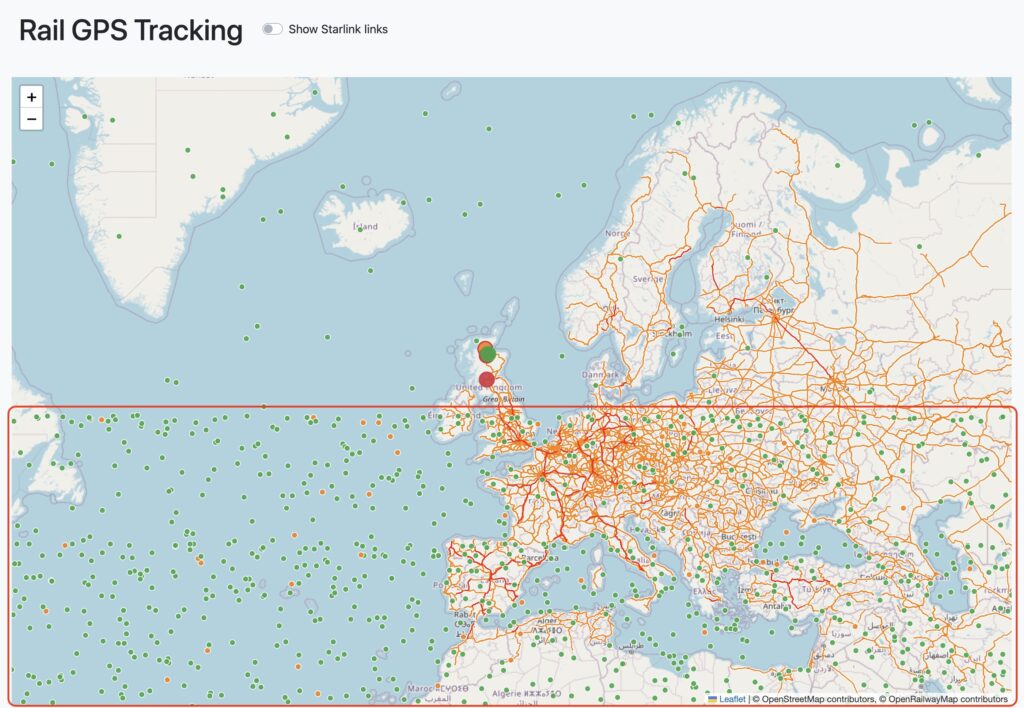
The published TLE data for the Starlink constellation shows there is evidently less capacity above 53rd parallel than below. This means if you’re a southern-based rail company, looking to put Starlink on your trains, the availability of coverage is extremely good, even for a rail company which goes south to north and back. If you’re a railway company operating much further north, this ‘could’ present problems for resilience, availability and reliability. As part of the trial, this was one of the key things we wanted to establish. Would this lesser capacity have presented a problem for the antenna on the 158 because based on the mounting location of the antenna, it was possible some signal related problems may have been experienced, especially on the curved and undulating routes the train would be taking.
As the custom platform we’ve built with Scotrail performs a check against the Starlink unit every 5 seconds, we have detailed telemetry data, geo-mapped to the location and time of the status change. The results of the trial so far have been amazing. Whilst the trains do alert to ‘searching’, ‘obstructed’, or ‘no_downlink’ states due to trees, hills, or other obstruction type.
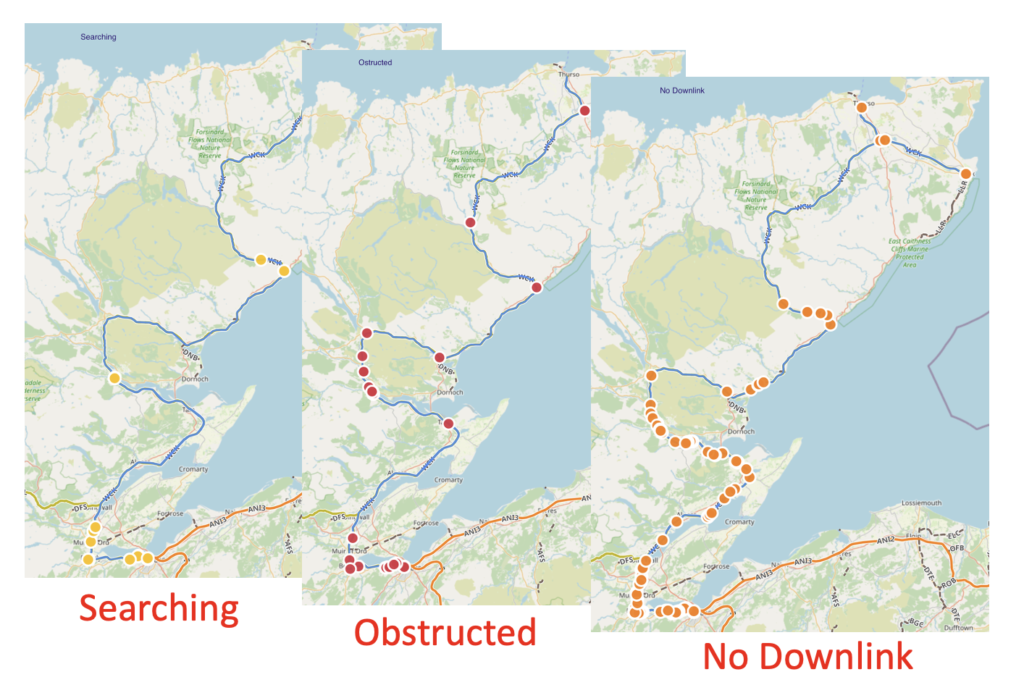
The overall effect is minimal, and thanks to the amazing capabilities of the electronic phased array tile from Starlink, the ‘connected’ state is far more impressive allowing for consistent, reliable connectivity.
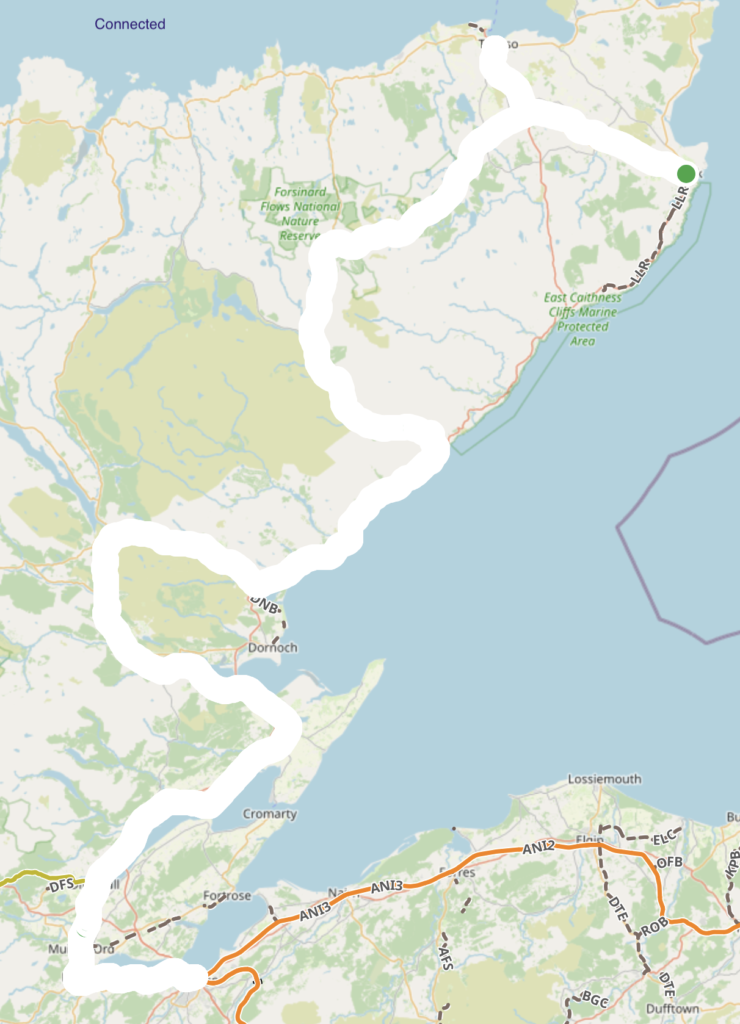
This situation is generally improving too, with SpaceX launching more Starlink satellites to fillout the coverage expected in late 2025.
To help evaluate the link quality the custom platform uses everyone’s favorite measure of how good, bad or pitiful the internet is, a Speedtest.
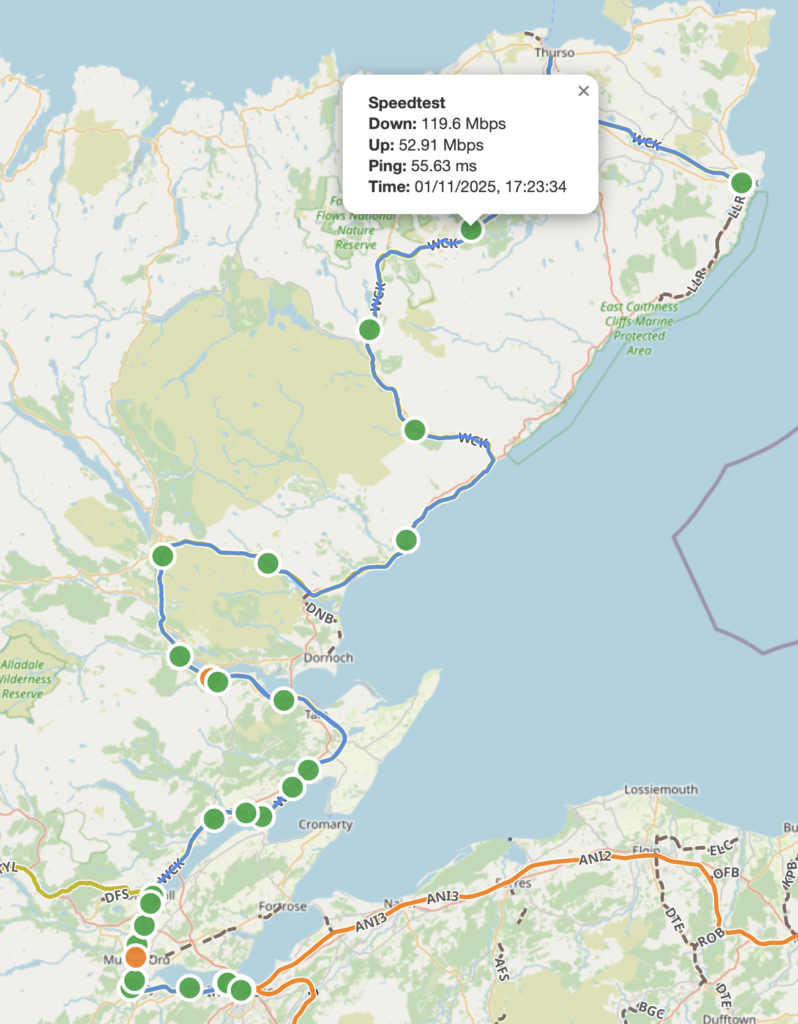
Tests are performed against each online 158 set every 20 minutes, with the data stored in a central database for reporting.
It’s quite eye opening to note that Starlink is providing a reliable 120Mbps down and 52Mbps up level of service in the middle of a nature reserve in the Highlands of Scotland.
Working in collaboration with ScotRail IT and depot engineering on this project has been a fascinating experience—professionally uplifting and genuinely enjoyable. Scotrail IT and we have also come away from the conference full of ideas from industry partners on how else improve services on-board for customers and services alike.